Synthesis of Cis-endo-dimethyl bicyclo-[2.2.1]-heptane-2,3- dicarboxylate from maleic anhydride and cyclopentadiene
BO AH JUNG & HANSOL KIM
Department of Chemistry and Biochemistry, Calvin College,Grand Rapids, MI 49546
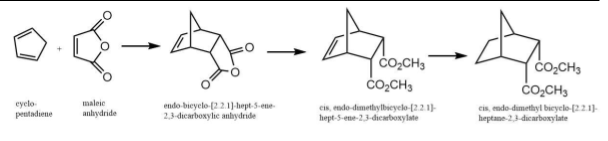
The purpose of this experiment is to initially use cyclopentadiene and maleic anhydride to form a final product of cis, endo-dimethyl bicyclo-[2.2.1]-heptane-2,3-dicarboxylate. The synthesis of the product was performed through three processes; first with Diels-Alder, second with fischer esterification and acid catalyzed solvolysis, and third with hydrogenation. Thus in the end, 1.80g of a transparent liquid product was successfully obtained.
Introduction:Cis-endo-dimethylbicyclo-
[2.2.1]-heptane-2,3- dicarboxylate (C11H 14 O 4) is an organic compound with a 6 carbon and 6 hydrogen spin systems. The main purpose of the synthesis was for a scientific implementation in obtaining an uncommon compound. The approach used in this experiment is as follows:
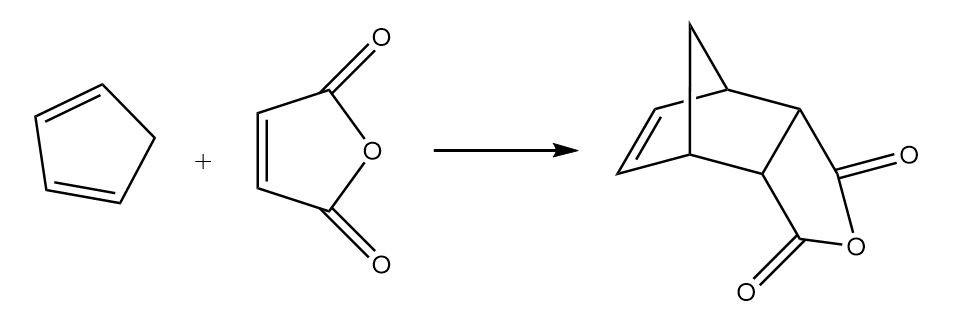
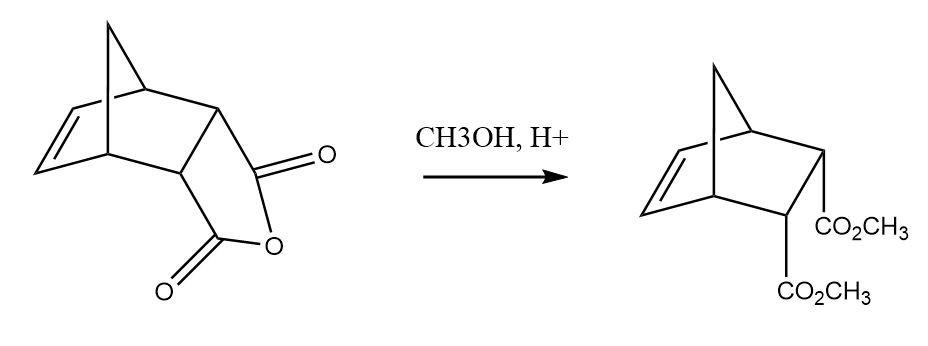
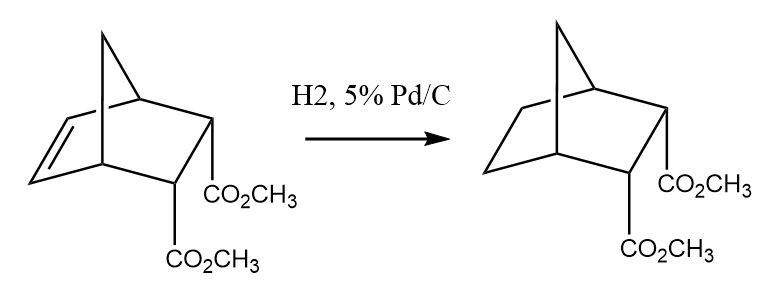
The first experiment was simply done using Diels-Alder reaction in which cyclopentadiene reacted with maleic anhydride to form endo-bicyclo-[2.2.1]-hept-5-ene-2,3-dicarbo xylic anhydride. The second experiment was done using the fischer esterification where excess methanol was used to form cis, endo-dimethyl bicyclo-[2.2.1]-hept-5-ene,2,3-dicarboxylate. The last experiment was done by the hydrogenation reaction to reduce the alkene to alkane; thus overall experiment was synthesized to form cis, endo-dimethylbicyclo-[2.2.1]-heptane-2,3-dicarbo xylate.
Results & Discussion: The reactions were successful based on the Infrared spectroscopy (IR) and Nuclear Magnetic Resonance (NMR) spectroscopy of Proton and Carbon, as well as the physical and property changes. The IR spectroscopy was not remarkable throughout this particular scheme, since there was no drastic change of a functional group displayed in it. The significant change resulted from the first reaction can be clearly seen from the NMR. The 1H NMR of the reactants, cyclopentadiene[1] and maleic anhydride[2], each showed a hydrogen spin systems of 3 and 1 while the IR of the product showed 5. The second reaction resulted in a physical change from a white solid to a transparent liquid. Furthermore, both the 1H and 13C NMR showed an increased number of spin systems from 5 to 6 peaks. The appearance of a high peak at 3.18ppm of the second product’s proton NMR proved the presence of the two methyl groups. The last reaction was the hydrogenation so the focus was the disappearance of the alkene. The 1H NMR of the second product had a peak at 6.16ppm while the final product had a peak at 1.24ppm instead.
Conclusion: The purpose of this experiment was to react cyclopentadiene with maleic anhydride to form a final product of cis, endo-dimethyl bicyclo-[2.2.1]-heptane-2,3-dicarboxylate. The overall synthesis produced the final product with a mass of 1.8027g and resulted in a percent yield of 87.1%. Hydrogenation could be further optimized as an impurity was developed.
Procedure of 1st reaction[3]: Diels-Alder reaction of cyclopentadiene and maleic anhydride
Dissolve 5g of maleic anhydride in ethyl acetate in a 125 Erlenmeyer flask. Add 20 mL of petroleum ether and dissolve it completely (use heat if necessary but make sure no solid is present & cool it in a ice bath) before adding cyclopentadiene. Mix it and cool it in an ice bath. Recrystallize it (heat to dissolve the solid, cool it till products form, put it in an ice bucket). Collect the crystals using a Buchner funnel (ligroin as solvent).
Mass of the 1st product: 6.02 g Melting point: 159- 164 o C Percent Yield:
5.0011 g ma * 918 m.1o gl mmaa * 1 m1 oml oplr omdauct * mo1l6 p4r.1o6dguct
= 8.39 g product
6.02 g actual yield
8.39 theoretical yield * 100% = 71.8%
Procedure of 2nd reaction[4]: Fischer Esterification of endo-bicyclo-[2.2.1]-hept-5-ene-2,3- dicarboxylic anhydride
In a 100 mL round bottom flask, 5.01g of the first product, 35 mL of methanol, and 1 mL of sulfuric acid were placed. The mixture was then refluxed with stirring for about 90 minutes in a low-mid heat. After 90 minutes of reflux, the reaction mixture was cooled, and the methanol was removed by a rotary evaporator. The residue was dissolved with 45 mL of diethyl ether and it was transferred to a 125 mL separatory funnel. The ether solution was washed with two 15 mL of ice cold water, two 15 mL of cold 5% sodium bicarbonate, and one 15 mL of brine. The bottom layer was discarded each time. The remaining ether solution was then transferred to a 125 mL Erlenmeyer flask and dried with sufficient anhydrous magnesium sulfate for 10 minutes. The dried solution was then poured through a filter-funnel that was filled with loose cotton-wool into a clean dry pre-weighed 100 mL round bottom flask. The ether solvent was removed by the rotary evaporator. The final residue was blown with a gentle stream of air until there was no more weight changes.
Mass of the 2nd product: 4.51 g Percent yield:
[5].01 g 1st(P) * 1614 m.1o6l g1 s1ts(Pt(P) ) * 11 mmooll 21nsdt((PP)) * m2o1l 02.n2d3(gP)
= 6.42 g product
4.51 g actual yield
6.42 theoretical yield * 100% = 70.3%
Procedure of 3rd reaction5: Hydrogenation of cis, endo-dimethyl bicyclo-[2.2.1]-hept-5-ene -2,3- dicarboxylate
Place 5% Pd/C catalyst in a clean, dry Parr
hydrogenation bottle, followed by 2.05 g of cis, endo-dimethylbicyclo-[2.2.1]-hept-5-ene-2,3-dicar boxylate and 25 mL of methanol. Attach the stopper with the tube and slide the bottle into the guard screen. Then, set the assembly in the bottle holder and tighten the knurled clamping nuts. Close the gas release valve after filling and ventilating the bottle three times to make sure the air is replaced by hydrogen. Open the bottle valve when the the hydrogen tank is filled to ~50 psig. Start the shaker and let it run for 1 hour. Remove the bottle after stopping the shaker and closing the bottle valve for a time. Filter the reaction through a pad of Celite in a glass funnel. Concentrate the filtrate by rotary evaporator.
Mass of the 3rd product: 1.81 g Percent yield:
2.054g 2st(P) * 2110 m.2o3l g1 s1ts(Pt(P) ) * 11 mmooll 21nsdt((PP)) * m2o1l2 3.2rd5Pg)
= 2.07g product
1.8027 g actual yield
2.07 theoretical yield * 100% = 87.1%
Scheme 1.Diels Alder Reaction
Scheme 2.Fischer Esterification Reaction
Scheme 3.Hydrogenation Reaction
-Diels-Alder Cycloaddition: The Reaction of Cyclopentadiene with Maleic Anhydride http://home.miracosta.edu/dlr/210exp9.htm (accessed Mar 19, 2018).
-Personal communication with Professor Chad
Tatko, Department of Chemistry and
Biochemistry, Calvin College -Maleic anhydride (108-31-6)1HNMR https://www.chemicalbook.com/SpectrumEN_10831-6_1HNMR.htm (accessed May 8, 2018).
-Solvent NMRs https://facultystaff.richmond.edu/~wmyers/addl_m aterials/solvents.htm (accessed May 8, 2018).
[1] Maleic anhydride (108-31-6)1HNMR
[2] Solvent NMRs
[3] Diels-Alder Cycloaddition
[4] Personal communication with Professor Tatko
[5] Personal communication with Professor Tatko